
Asset management
Know Every Asset. Understand Its Condition. Plan Its Future.
A central register that carries an asset from procurement to disposal — and connects it to the work, data, documents and costs that accumulate along the way.
The business problem
The asset register and reality drift apart
Registers are often built once at handover and maintained in a spreadsheet afterwards. Equipment is replaced without the record changing, warranties expire unnoticed, maintenance history sits in email and paper service reports, and capital planning proceeds on age assumptions rather than observed condition.
The IntelliGrid approach
One register that operations actually uses
Because technicians reach the asset record through a QR scan to do their work, the register stays current as a by-product of daily operations. Every work order, reading, document and cost attaches to the asset, building the evidence base for condition assessment and capital planning.
Central asset register
What each asset record holds
And what connects to it
The asset management screen
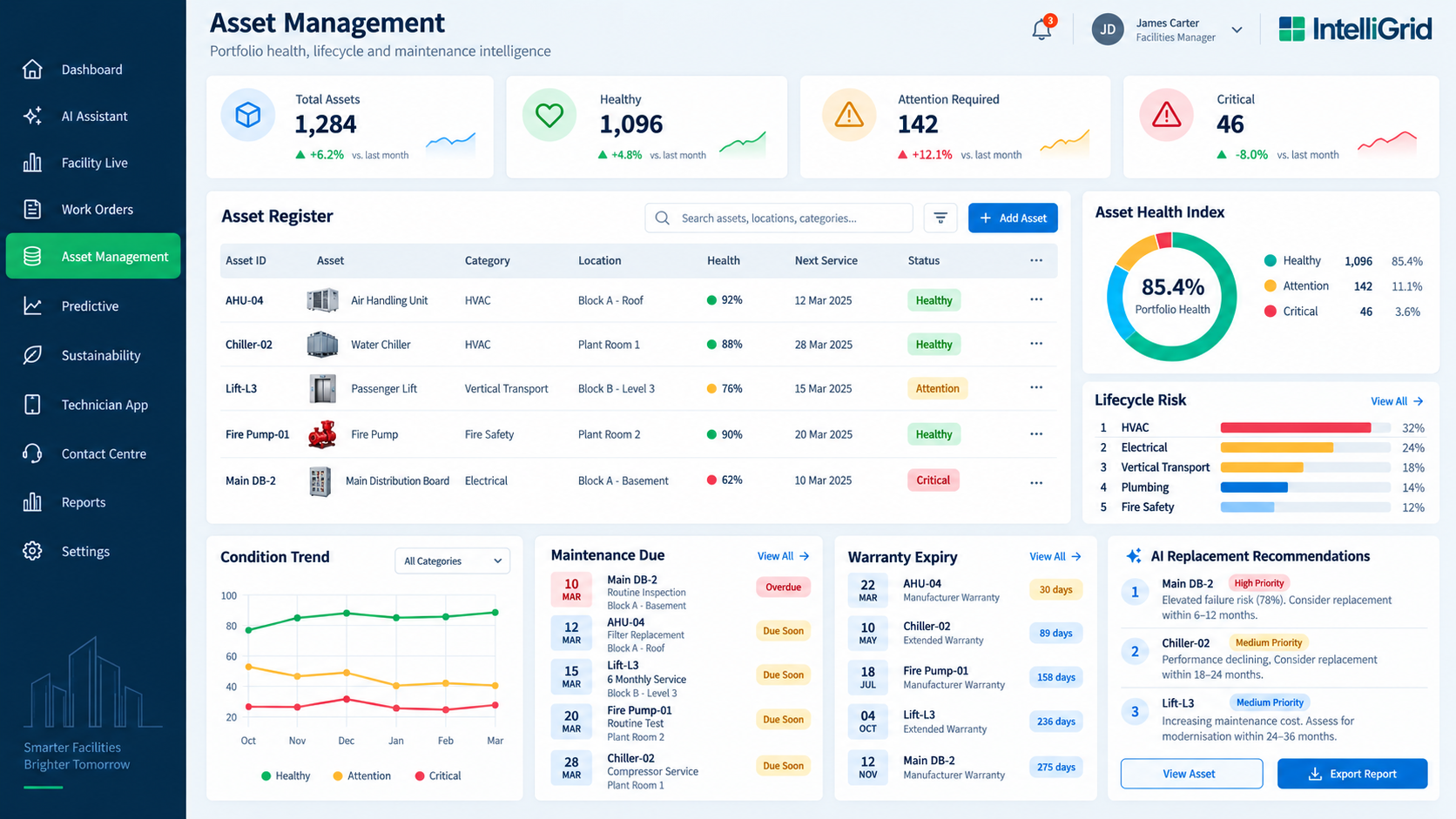
Interface shown with illustrative demo data.
Capabilities
Asset capabilities
Preventive plans
Maintenance plans per asset class with frequency, task list, duration and skill requirement.
Inspection routines
Scheduled inspections producing structured readings rather than free-text notes.
Condition monitoring
Telemetry and inspection results combined into a maintained condition position.
Maintenance history
Every work order, part and service report retained against the asset permanently.
Fault history
Recurring faults visible on the asset record so chronic equipment is identifiable.
Predictive risk
The current AI risk score and its contributing signals shown on the record.
Linked documents
Manuals, drawings, warranties and certificates attached to the asset, not a shared drive.
Acquisition cost
Purchase and installation cost retained as the basis for lifecycle analysis.
Depreciation
Book position tracked using your accounting convention.
Remaining life
An indicative position combining age, duty, condition and observed degradation.
Replacement budget
Cost and timing estimates for planned replacement of ageing equipment.
Capex forecast
Aggregate replacement demand across a building, site or portfolio by year.
Workflow
The asset lifecycle
Business benefits
Connects with
Build an intelligent asset register
We will discuss register structure, QR tagging, criticality rating and how existing data can be brought across.